
Gynecology
What Is an Ovarian Cyst? Symptoms, Types and Follow-Up
9 min read
What is an ovarian cyst, what symptoms does it cause and what types are there? Simple vs. complex cysts, where the pain is felt and when surgery is needed.
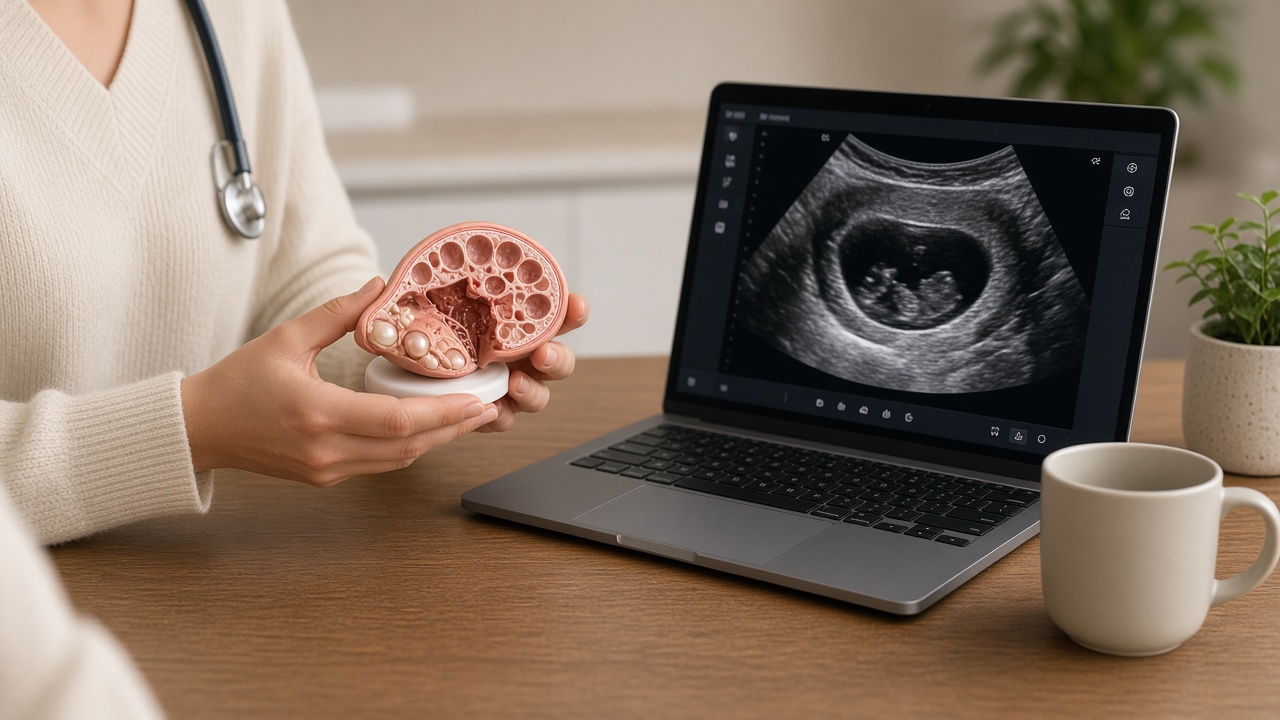
An ovarian cyst is a sac filled with fluid or semi-solid material that develops in or on the ovary. Ovarian cysts are common in women of reproductive age, and most are functional cysts: benign, linked to the menstrual cycle and gone on their own. The type, size and ultrasound appearance of the cyst determine whether it needs monitoring or treatment.
Key Points
- Most ovarian cysts cause no symptoms and are found by chance on a routine ultrasound.
- The most common type is the functional cyst, related to the menstrual cycle; most shrink on their own within a few cycles.
- Endometriomas ("chocolate cysts"), dermoid cysts and cystadenomas do not go away on their own.
- Pelvic pain, bloating, pain during sex and irregular periods are possible symptoms.
- Sudden, severe pelvic pain needs emergency evaluation for a ruptured cyst or ovarian torsion.
- The decision depends not only on size but also on the cyst's internal structure, your age and your symptoms.
How Does an Ovarian Cyst Form?
Each month, the ovaries develop and release an egg. The egg matures inside a fluid-filled sac called a follicle. At ovulation, the follicle ruptures, leaving behind a structure called the corpus luteum. If the follicle does not rupture, or if fluid or blood collects inside the corpus luteum, a cyst forms. These are called functional cysts.
There are also cysts unrelated to the menstrual cycle, arising from ovarian tissue itself or from conditions such as endometriosis. Because these cysts do not disappear on their own, they need monitoring or treatment.
Types of Ovarian Cysts
Functional cysts
- Follicular cyst: Forms when ovulation does not happen and the follicle keeps growing.
- Corpus luteum cyst: Develops when fluid fills the structure left behind after ovulation.
- Hemorrhagic cyst: Bleeding into a functional cyst; it can cause pain.
Most of these cysts shrink on their own within one to three cycles. For details, see our article on functional cysts.
Endometrioma ("chocolate cyst")
Forms when tissue similar to the uterine lining grows in the ovary. It contains dark, old blood, hence the name "chocolate cyst." It may be associated with severe period pain, pain during sex and difficulty getting pregnant. For more information, see our endometrioma page.
Dermoid cyst (mature cystic teratoma)
A usually benign cyst that can contain different tissues such as fat, hair and teeth. It does not go away on its own and, as it grows, can increase the risk of ovarian torsion. Details are in our article on dermoid cysts.
Cystadenomas
Cysts that develop from the surface tissue of the ovary and contain watery (serous) or sticky (mucinous) fluid. Most are benign but can grow large and are usually removed surgically.
Polycystic-appearing ovaries
In polycystic ovary syndrome, the many small follicles seen on the ovary are not true cysts. This is assessed separately as a hormonal condition.
Ovarian Cyst Symptoms
Many cysts cause no symptoms at all. When they do, symptoms may include:
- A dull or sharp pain in the pelvis on the side of the cyst
- Bloating, fullness or pressure in the abdomen
- Pain during or after sex
- Changes in your cycle, a late period or bleeding between periods
- Frequent urination or constipation (from a large cyst pressing on the bladder or bowel)
- Pain spreading to the lower back or leg
Where do you feel ovarian cyst pain?
The pain is usually felt in the pelvis on the side of the cyst. In some women it spreads to the lower back, hip or upper thigh. However, these symptoms can also come from muscles and joints, the bowel or the urinary tract, so the source of the pain should be confirmed with an examination and ultrasound.
Emergency symptoms
Go to the emergency department without delay if you have:
- Sudden, severe pelvic pain
- Nausea or vomiting along with the pain
- Dizziness, feeling faint or a cold sweat
- Abdominal pain with fever
These symptoms may point to a ruptured cyst, bleeding into a cyst or twisting of the ovary (ovarian torsion).
How Is an Ovarian Cyst Diagnosed?
Pelvic exam and ultrasound
Ultrasound is the main diagnostic tool. A transvaginal ultrasound shows the ovaries up close and clearly. For women who have not been sexually active, an abdominal or transrectal ultrasound may be used instead. The ultrasound assesses the cyst's size, wall thickness, internal structure, whether it has septations or solid areas, and its blood flow.
Simple vs. complex cysts
| Feature | Simple cyst | Complex cyst |
|---|---|---|
| Contents | Clear fluid | Septations, solid areas, blood or mixed contents |
| Wall | Thin and smooth | May be thick or irregular |
| Approach | Usually monitoring | Further tests and detailed evaluation |
Most complex-looking cysts are also benign (for example, hemorrhagic cysts, endometriomas and dermoid cysts), but they may need further tests.
Blood tests and further imaging
When needed, a pregnancy test, tumor markers such as CA-125, or an MRI may be ordered. CA-125 can also be raised by endometriosis, menstruation and some inflammatory conditions, so it cannot make a diagnosis on its own; the result is always interpreted together with the examination findings.
Ovarian Cyst Treatment: The General Approach
Treatment decisions depend on the type and size of the cyst, your age, whether you have reached menopause, your symptoms and your pregnancy plans.
- Monitoring: For simple-looking functional cysts without symptoms, a follow-up ultrasound is usually done after 6–12 weeks.
- Pain management: For mild pain, pain relievers recommended by your doctor can be used.
- Hormonal methods: Birth control pills do not dissolve an existing cyst, but they may be recommended to some women to reduce the formation of new functional cysts.
- Surgery: May be needed for cysts that do not go away, grow, cause pain or look complex, or if torsion is suspected. It is usually done laparoscopically, preserving the ovarian tissue.
Treatment options are explained in detail on our ovarian cyst treatment page, and the surgical process on our ovarian cyst surgery page.
Do Ovarian Cysts Prevent Pregnancy?
Functional cysts generally do not affect fertility. Endometriomas, however, are linked to endometriosis and can make it harder to get pregnant. If surgery is needed, preserving healthy ovarian tissue is especially important for women who want children. If you are planning a pregnancy, tell your doctor, as it directly affects the treatment plan.
Ovarian Cysts After Menopause
Because ovulation stops after menopause, functional cysts are not expected. Still, small, simple-looking cysts can be seen on ultrasound at this stage, and many of them are benign. Postmenopausal cysts are evaluated more carefully: the internal structure, size, blood flow and, if needed, tumor markers are all considered together. Small, simple-looking cysts can often be monitored with regular ultrasounds; cysts with septations or solid areas, or that are growing, call for further evaluation and surgical planning.
What to Keep in Mind During Follow-Up
- Have your follow-up ultrasound when your doctor recommends, ideally early in your menstrual cycle.
- If your pain gets worse, your waistline changes or your cycle changes, come in without waiting for your scheduled check-up.
- Bring your previous ultrasound reports; comparing changes in the cyst's size helps guide decisions.
- Herbal "cyst-dissolving" remedies found online have no proven effectiveness; talk to your doctor before using them.
Frequently Asked Questions
Do ovarian cysts go away on their own?
Most functional cysts shrink and disappear on their own within one to three cycles. Endometriomas, dermoid cysts and cystadenomas do not go away on their own. A follow-up ultrasound clarifies the type of cyst.
When does an ovarian cyst cause pain?
A cyst can cause pain when it grows, bleeds, ruptures or causes the ovary to twist. In some women, pain is more noticeable around ovulation or during periods. Sudden, severe pain needs emergency evaluation.
Can an ovarian cyst delay my period?
Some functional cysts produce hormones that can affect the menstrual cycle, causing a late period or irregular bleeding. If your period is late, pregnancy should be ruled out first.
Is an ovarian cyst passed with your period?
Cysts are not passed out with menstrual bleeding. Functional cysts are reabsorbed by the body and shrink; because this often happens during the next cycle, it can seem as if the cyst "came out with the period."
At what size is an ovarian cyst removed?
There is no single size cut-off. In general, surgery is considered for cysts larger than 5 cm that do not shrink within a few months, or that grow, cause pain or look complex. The decision depends on your age, menopausal status and the cyst's internal structure.
Can an ovarian cyst cause cancer?
In women of reproductive age, the vast majority of ovarian cysts are benign. Cysts that develop after menopause, contain solid areas or grow quickly are evaluated more carefully, and further tests are done if anything looks suspicious.
What happens if an ovarian cyst is not treated?
Functional cysts usually disappear without treatment. Cysts that need monitoring, however, can grow over time and cause pain, ovarian torsion or rupture. That is why it is important to keep the follow-up appointments your doctor recommends.
This article is for general information only and does not replace diagnosis or treatment. A personal assessment requires an examination.
This page is general information. Your own plan is set after examination.